PE Tube vs ABL Tube vs PBL Tube: Complete Comparison for Cosmetic Packaging
Sep 22, 2026
PE Tube vs ABL Tube vs PBL Tube: Complete Comparison for Cosmetic Packaging
When choosing packaging for skincare, personal care, and cosmetic products, the tube material can have a significant impact on product protection, appearance, shelf life, sustainability, and overall packaging performance.
Among the most commonly used tube materials are PE, ABL, and PBL. Each material has its own characteristics and is suitable for different cosmetic formulations and brand requirements.
For cosmetic brands, contract manufacturers, and packaging buyers, understanding the differences between PE tubes, ABL tubes, and PBL tubes can make it easier to select the right packaging solution for a specific product.
In this guide, we will compare PE Tube vs ABL Tube vs PBL Tube from multiple perspectives, including material structure, barrier properties, appearance, printing, applications, sustainability, and customization options.
1. What Are PE, ABL, and PBL Cosmetic Tubes?
Before comparing the three options, it is useful to understand their basic structures.
PE Tubes
PE tubes are made primarily from polyethylene and are widely used for cosmetic and personal care packaging.
Depending on the packaging design, PE tubes can be produced with different layers and specifications. They offer good flexibility, impact resistance, and compatibility with many everyday cosmetic formulations.
PE tubes are commonly used for:
Face wash
Cleansing cream
Hand cream
Body lotion
Sunscreen
Hair care products
Body scrub
Moisturizing cream
Personal care products
They are a practical choice for brands looking for flexible and cost-effective tube packaging.
ABL Tubes
ABL stands for Aluminum Barrier Laminate.
An ABL tube typically contains an aluminum barrier layer between polymer layers. This structure provides a strong barrier against oxygen, moisture, light, and other external factors.
Because of its barrier performance, ABL packaging is often selected for products that are more sensitive to environmental exposure.
Common applications include:
Eye cream
Repair cream
Skin treatment products
Sunscreen
High-performance skincare
Pharmaceutical and personal care products
Products requiring enhanced barrier protection
ABL tubes can also create a premium metallic appearance that is attractive for certain cosmetic packaging designs.
PBL Tubes
PBL stands for Plastic Barrier Laminate.
Unlike ABL, which contains an aluminum barrier layer, PBL uses a polymer-based barrier structure.
PBL tubes are designed to provide enhanced barrier performance while maintaining a plastic-based appearance and structure.
They are often used for:
Skincare creams
Facial cleansers
Sunscreen
Body care products
Hair care products
Sensitive formulations
Premium cosmetic products
PBL can be a useful option when a brand requires stronger barrier performance but prefers a plastic-based packaging structure.
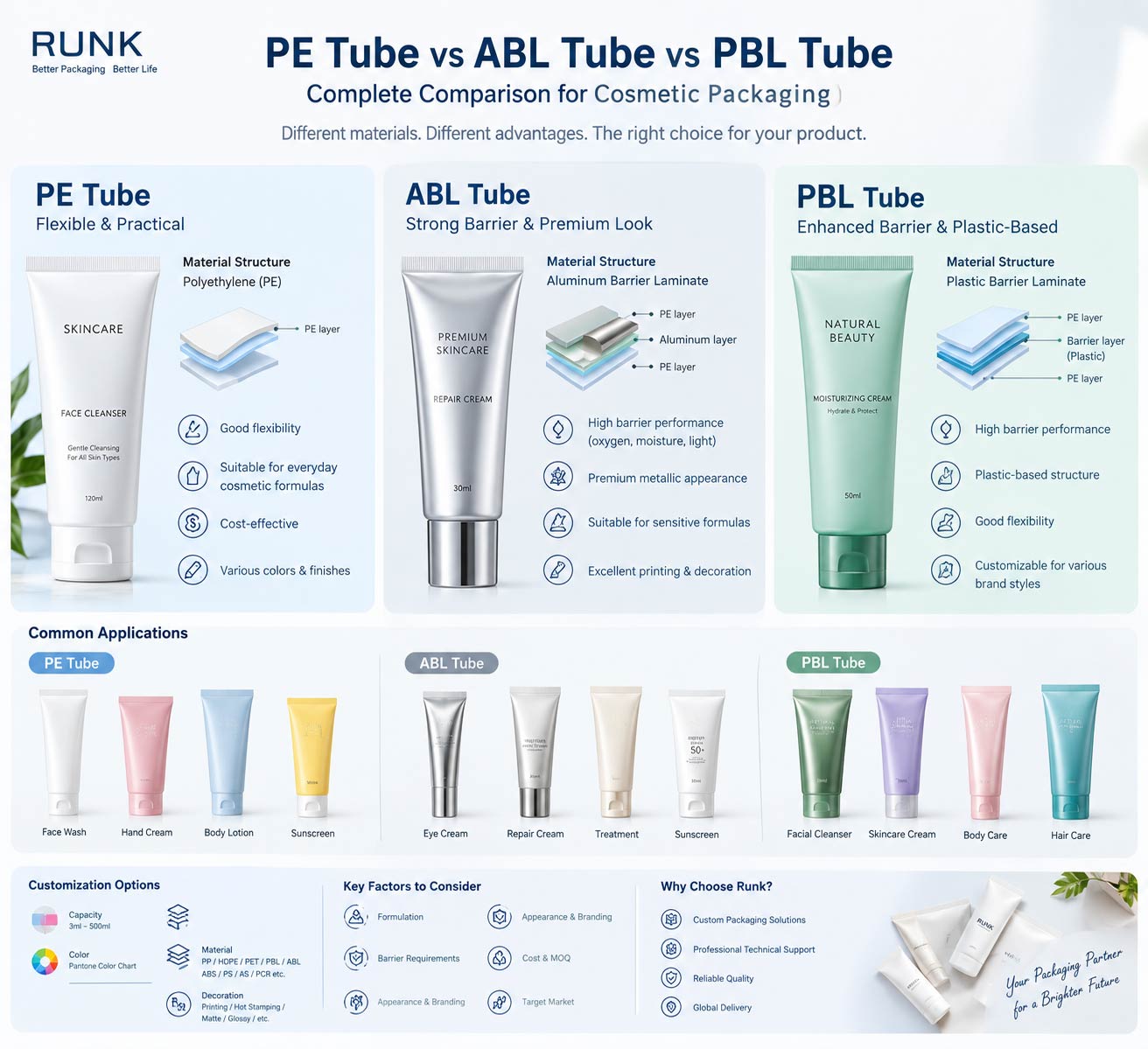
2. PE Tube vs ABL Tube vs PBL Tube: Key Differences
The biggest differences between these three tube materials are related to their barrier structure, appearance, flexibility, product compatibility, and packaging requirements.
Feature
PE Tube
ABL Tube
PBL Tube
Main structure
Polyethylene
Aluminum barrier laminate
Plastic barrier laminate
Oxygen barrier
Good depending on structure
High
High
Moisture barrier
Good
High
High
Light protection
Limited to color and structure
Excellent
Good to high
Flexibility
High
Good
Good
Metallic appearance
Usually no
Possible
Usually no
Plastic-based structure
Yes
No
Yes
Printing options
Flexible
Highly flexible
Highly flexible
Premium appearance
Good
Excellent
Excellent
Typical use
Everyday cosmetics
Sensitive and high-barrier formulas
Cosmetics requiring enhanced barrier protection
The actual performance of a tube depends not only on the material name but also on its layer structure, thickness, diameter, cap, sealing method, formulation, and manufacturing process.
Therefore, brands should evaluate the complete packaging system rather than selecting a material based on one characteristic alone.
3. Barrier Performance: Which Tube Provides Better Protection?
Barrier performance is one of the most important considerations when selecting cosmetic tube packaging.
A packaging barrier helps protect the formulation from external factors such as:
Oxygen
Moisture
Light
Odors
External contamination
PE Tube Barrier Performance
Standard PE tubes can provide suitable protection for many everyday cosmetic products.
They are commonly selected when the formulation does not require an extremely high barrier against oxygen or light.
For products such as hand cream, body lotion, cleansing products, and many general skincare formulations, PE tubes can provide a practical packaging solution.
ABL Tube Barrier Performance
ABL tubes contain an aluminum barrier layer, which can provide strong protection against oxygen, moisture, and light.
This makes ABL a suitable option for formulations where external exposure may affect product stability or performance.
For example, some active skincare formulations, treatment creams, and sunscreen products may benefit from enhanced barrier protection.
PBL Tube Barrier Performance
PBL tubes use a plastic-based barrier structure to provide enhanced protection.
They can be considered when a brand wants stronger barrier performance while maintaining a plastic-based tube structure and appearance.
However, the exact barrier performance depends on the specific laminate construction selected for the packaging.
4. Which Tube Is More Suitable for Skincare Products?
There is no single tube material that is suitable for every skincare product.
The right choice depends on the formulation and the brand's packaging requirements.
PE Tubes for Everyday Skincare
PE tubes are commonly suitable for:
Moisturizers
Hand creams
Cleansers
Body creams
Body scrubs
General skincare products
They offer a balance between flexibility, functionality, and cost.
ABL Tubes for High-Protection Skincare
ABL tubes can be considered for products where enhanced protection from oxygen, moisture, and light is important.
Typical applications include:
Eye creams
Repair creams
Treatment creams
Sunscreens
Active skincare formulations
PBL Tubes for Barrier-Focused Cosmetic Packaging
PBL tubes can be suitable for cosmetic brands looking for enhanced barrier properties with a plastic-based structure.
They can be used for:
Facial creams
Cleansers
Sunscreens
Body care products
Hair care products
Sensitive formulations
The final choice should ideally be confirmed through compatibility and stability testing with the actual formulation.
5. PE Tube vs ABL Tube vs PBL Tube: Appearance
Packaging appearance plays an important role in cosmetic branding.
PE Tube Appearance
PE tubes can be produced in different colors and finishes and can support various printing and decoration techniques.
They are suitable for both simple everyday packaging and customized branded designs.
ABL Tube Appearance
ABL tubes can provide a distinctive metallic appearance because of the aluminum barrier layer.
This can help create a premium visual effect, especially when combined with printing, glossy finishes, matte finishes, or other decorative treatments.
PBL Tube Appearance
PBL tubes can provide a clean and modern appearance while maintaining the benefits of a plastic barrier laminate structure.
They can be customized with different colors, finishes, and printing effects to match different brand identities.
6. Printing and Decoration Options
Cosmetic brands often require packaging that can communicate their visual identity clearly.
Depending on the tube structure and design, common decoration options include:
Silk Screen Printing
Offset Printing
Hot Stamping
Plating
Frosted Finish
Matte Finish
Glossy Finish
Pearl Effect
Labeling
Shiny Decoration
For premium cosmetic packaging, multiple decorative techniques can also be combined.
For example, a tube may use a matte body with glossy printing and hot stamping to create a more sophisticated visual effect.
7. Flexibility and User Experience
The flexibility of a cosmetic tube directly affects how consumers use the product.
PE tubes are generally flexible and easy to squeeze, making them popular for products designed for frequent use.
ABL and PBL tubes can also provide good squeezability, but the overall user experience depends on the tube diameter, wall structure, material combination, and product viscosity.
The packaging should therefore be evaluated together with the formula.
A thick cream, lightweight lotion, cleansing gel, and sunscreen may require different tube structures even when they use the same general tube material.
8. Sustainability Considerations
Sustainability is becoming increasingly important in cosmetic packaging.
When comparing PE, ABL, and PBL, it is important to consider more than just the base material.
Factors such as:
Material composition
Number of layers
Recycled content
Production process
Packaging weight
Transportation efficiency
Recycling infrastructure
Local packaging regulations
can all influence the overall environmental profile of a packaging solution.
For brands developing sustainable packaging, PCR and bio-based material options may also be considered where technically appropriate.
The recyclability of a specific tube should always be evaluated according to its actual material structure and the recycling system available in the target market.
9. Cost Considerations
Packaging cost depends on many factors, so PE, ABL, and PBL should not be compared only by material price.
The total packaging cost may be affected by:
Tube material
Tube diameter
Capacity
Wall thickness
Number of layers
Cap design
Decoration
Printing colors
Surface finishing
Order quantity
Mold requirements
Packaging and shipping
PE tubes are often considered a practical solution for standard cosmetic applications.
ABL and PBL tubes may be selected when additional barrier performance or a specific premium packaging appearance is required.
For large-volume projects, the most appropriate solution should be evaluated based on both packaging performance and total project cost.
10. How to Choose the Right Cosmetic Tube Material?
When selecting between PE, ABL, and PBL, cosmetic brands can consider the following questions:
1. Does the formula require enhanced barrier protection?
If the product is particularly sensitive to oxygen, moisture, or light, ABL or PBL may be worth considering.
2. What type of cosmetic product is being packaged?
A hand cream, facial cleanser, sunscreen, eye cream, and treatment product may have different packaging requirements.
3. What appearance does the brand want?
If a metallic or premium appearance is important, ABL can provide distinctive visual possibilities.
4. Does the brand have sustainability requirements?
Brands should evaluate the complete material structure and target-market recycling system rather than looking only at whether the tube is labeled plastic or laminate.
5. What is the target price?
The packaging solution should match the product's positioning and expected production volume.
6. What decoration is required?
Printing and finishing requirements can influence the most suitable tube construction.
11. Cosmetic Tube Customization Options
At Runk, cosmetic tubes can be customized according to four main options:
Capacity
Tube capacity ranges from 3ml to 500ml.
The available capacity depends on the tube diameter and overall tube design.
Color
Tube colors can be customized according to the Pantone Color Chart, helping brands create packaging that matches their visual identity.
Material
Different material options can be selected according to product and packaging requirements, including:
PP
HDPE
PET
PBL
ABL
ABS
PS
AS
PCR
Sugarcane-based materials
Other suitable material structures
Decoration
Available decoration options can include:
Silk Screen Printing
Shiny Decoration
Offset Printing
Plating
Frosted Finish
Matte Finish
Glossy Finish
Labeling
Pearl Effect
Hot Stamping
The final combination can be developed according to the product formula, packaging requirements, target market, and brand positioning.
12. PE Tube vs ABL Tube vs PBL Tube: Which One Should You Choose?
Instead of asking which material is universally better, cosmetic brands should ask which tube structure is better suited to the specific product.
PE tubes can be a practical choice for everyday skincare and personal care products that require flexible and customizable packaging.
ABL tubes can be considered when stronger barrier protection and a distinctive premium appearance are important.
PBL tubes can be considered when enhanced barrier performance is required while maintaining a plastic-based laminate structure.
The best packaging solution depends on the formulation, product stability requirements, appearance, sustainability goals, decoration, capacity, and target market.
Frequently Asked Questions About PE, ABL, and PBL Tubes
1. What is the main difference between PE and ABL tubes?
The main difference is the barrier structure.
PE tubes primarily use polyethylene, while ABL tubes contain an aluminum barrier layer between polymer layers. ABL tubes generally provide stronger protection against oxygen, moisture, and light.
2. What is the difference between ABL and PBL tubes?
ABL means Aluminum Barrier Laminate, while PBL means Plastic Barrier Laminate.
ABL uses an aluminum barrier layer, while PBL uses a plastic-based barrier structure.
Both can provide enhanced barrier protection, but their material structures, appearance, processing characteristics, and recycling considerations can differ.
3. Are PE tubes suitable for sunscreen?
PE tubes can be used for sunscreen products, depending on the formulation and packaging requirements.
For sunscreen formulas that require enhanced protection from external factors, brands may also consider ABL or PBL structures.
Packaging compatibility and stability testing should be performed with the final formulation.
4. Are ABL tubes suitable for eye cream?
Yes. ABL tubes are commonly considered for products such as eye creams and repair creams where enhanced barrier protection is desirable.
The final packaging structure should still be selected according to the actual formula.
5. Are PBL tubes recyclable?
The answer depends on the specific PBL structure and the recycling infrastructure in the target market.
Because PBL tubes may contain multiple polymer layers and barrier materials, brands should evaluate the actual construction and local recycling requirements before making recyclability claims.
6. Which tube material is best for active skincare products?
There is no universal answer.
Active skincare products can have different sensitivities to oxygen, light, moisture, and other environmental factors.
ABL or PBL may be considered when enhanced barrier performance is required, while PE can be suitable for formulations with less demanding barrier requirements.
7. Can PE, ABL, and PBL tubes all be customized?
Yes. Cosmetic tubes can be customized in terms of capacity, color, material structure, and decoration, depending on the specific tube design and manufacturing requirements.
8. What tube sizes are available?
Cosmetic tubes can be produced in different capacities for different applications.
At Runk, tube capacity can range from 3ml to 500ml, with the available capacity depending on the tube diameter and design.
9. Can cosmetic tubes be printed with a brand logo?
Yes.
Depending on the tube structure and design, options such as silk screen printing, offset printing, hot stamping, labeling, matte finishing, glossy finishing, and other decorative techniques can be used.
10. Can the tube color match our brand color?
Yes.
Custom tube colors can be developed according to the Pantone Color Chart, helping brands maintain consistent visual branding across their packaging.
11. Which tube is more suitable for premium cosmetic packaging?
Both ABL and PBL can be used for premium cosmetic packaging, while PE tubes can also achieve a premium appearance through customized colors, printing, and surface decoration.
The final appearance depends on the complete packaging design rather than the tube material alone.
12. How do I choose the right tube for my cosmetic formula?
Consider the following factors:
Product formulation
Barrier requirements
Product sensitivity to oxygen or light
Product viscosity
Desired capacity
Tube diameter
Brand appearance
Decoration requirements
Sustainability goals
Target market and packaging regulations
If you are unsure which structure is suitable, packaging suppliers can evaluate the formula and product requirements before confirming the final tube specification.
Conclusion
PE, ABL, and PBL tubes each have their own advantages and application scenarios.
PE tubes offer flexible and practical packaging solutions for many everyday cosmetic and personal care products.
ABL tubes provide an aluminum barrier layer and can be suitable for products requiring enhanced protection, while also offering a distinctive premium appearance.
PBL tubes provide a plastic-based barrier structure and can be considered for products requiring enhanced barrier performance with a plastic laminate construction.
For cosmetic brands, the right choice should be based on the formula, barrier requirements, appearance, sustainability considerations, decoration, capacity, and target market.
At Runk, we provide customized cosmetic packaging solutions for skincare, personal care, beauty, and other applications. Our team can help develop tube packaging based on your product requirements, including capacity, color, material, and decoration.
Whether you need PE, ABL, PBL, or another suitable cosmetic tube structure, choosing the right packaging from the beginning can help create a more reliable product and a stronger brand presentation.
Contact : info@runkgroup.com | +86-13128608159
Runk Website :
https://www.runkgroup.com/
https://www.runkbottle.com/
https://runkpackaging.en.alibaba.com/
Based in Guangzhou, China – serving beauty brands worldwide.
Mehr lesen



 IPv6-Netzwerk unterstützt
 Deutsch